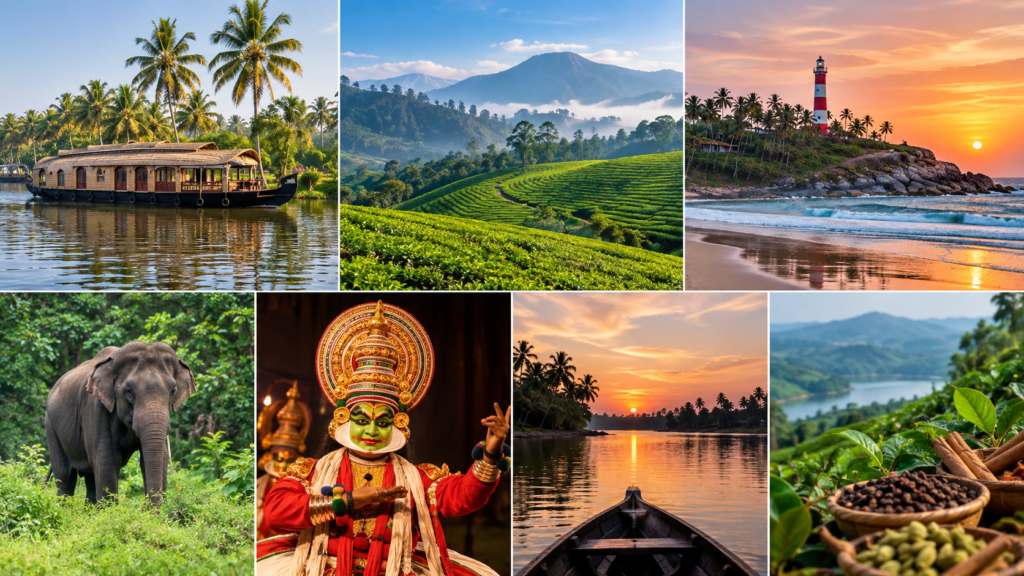
Kerala’s geography does a lot of the work for you. Within a few hundred kilometres, the state moves from hill stations and wildlife reserves to backwater networks and paddy fields, then to a long, relatively clean coastline. That variety is why a well-structured itinerary here rarely feels like it’s covering the same ground twice, and it’s also why the attractions that appear most consistently in Kerala family tour packages tend to be genuinely different from each other in character.
What follows is a look at the places that appear most reliably across Kerala itineraries, what they offer, and who they suit best.
Top 7 Places & Attractions in Kerala
Munnar
At around 1,600 metres above sea level in the Western Ghats, Munnar is the hill station most Kerala itineraries anchor around. The tea estates here, managed largely by Tata Tea and a handful of smaller growers, cover the hillsides in a particular shade of green that photographs well but looks better in person. The Eravikulam National Park, a short drive from the town centre, is home to the Nilgiri tahr and offers one of South India’s more accessible wildlife walks.
Munnar suits most traveller types. Families appreciate the cool air and manageable terrain. Couples tend to gravitate toward the more secluded estate resorts. Women-only groups often find the town safe, easy to navigate, and well served by homestays run by local families. The Tea Museum at Nallathanni is worth a visit for the context it provides on the region’s colonial and agricultural history.
Alleppey (Alappuzha) and the Backwaters
Alleppey is the departure point for most houseboat itineraries on the Kerala backwater network, a system of lakes, rivers, and canals that stretches roughly 900 kilometres along the coast. A night on a kettuvallam, the traditional rice boat converted for tourism, remains one of the most distinctive accommodation experiences in India.
The backwaters appear in almost every Kerala family tour package for good reason. The experience is low-effort and high-reward: a crew handles everything, meals are prepared on board, and the scenery changes slowly enough that the trip never feels rushed. Vembanad Lake, the largest lake in Kerala, is the main body of water most houseboats traverse, and the light over it in the early morning and late afternoon is genuinely worth staying up or waking early for.
Thekkady and Periyar Tiger Reserve
Thekkady is the gateway town to the Periyar Tiger Reserve, one of India’s better-managed wildlife sanctuaries and part of Project Tiger since 1978. The boat safari on Periyar Lake runs for roughly two hours and offers sightings of elephants, gaur, wild boar, and deer in a setting that requires no hiking and no particular fitness level, making it accessible to a wide range of travellers.
The surrounding area is dense with spice plantations, and guided walks through cardamom, pepper, and vanilla estates are a standard part of most Thekkady itineraries. The Elephant Junction and Periyar Nature Walk are both frequently included in organised packages and work well as half-day additions.
For women tour packages specifically, Thekkady is consistently rated as one of the more comfortable and welcoming destinations in Kerala. The town is small, walkable, and has a calm character that makes solo and group travel feel easy.
Fort Kochi
Fort Kochi is the cultural and historical counterpoint to Kerala’s natural attractions. The neighbourhood carries visible traces of Portuguese, Dutch, and British colonial presence: the Chinese fishing nets along the waterfront, the Santa Cruz Basilica, the Dutch Cemetery, the Jewish Synagogue in Mattancherry, and a stretch of streets that read more like a small European town than a South Indian city.
The Kathakali and Kalaripayattu performance centres in Fort Kochi offer accessible introductions to two of Kerala’s most significant classical art forms. The evening performances are short enough not to feel demanding and are formatted specifically for audiences unfamiliar with the traditions. The neighbourhood’s café and gallery scene is strong, and the overall pace is unhurried in a way that rewards wandering rather than ticking off an itinerary.
Fort Kochi appears in most standard Kerala packages as either a starting or ending point, and both positions work well. As a first stop, it eases travellers into Kerala’s pace. As a final stop, it offers enough cultural texture to close a trip on something other than a long airport transfer.
Wayanad
Wayanad sits in the northern part of Kerala’s hill country and offers a quieter, less-visited version of the hill-station experience than Munnar. The Wayanad Wildlife Sanctuary is home to elephants, leopards, and a significant population of the endangered lion-tailed macaque. Chembra Peak, at 2,100 metres the highest point in Wayanad, is a popular half-day trek with a heart-shaped lake near the summit that has become something of a landmark.
Edakkal Caves, with their Neolithic and Mesolithic rock carvings, are among Kerala’s more historically significant sites and tend to appeal to older children and travellers interested in archaeology. The coffee and tea estates that cover much of Wayanad’s mid-altitude terrain make for pleasant, easy walking, and several of the better resorts here are built within working plantations.
Wayanad features regularly in women tour packages for its safe environment, strong homestay culture, and manageable geography. Solo and group travellers report feeling comfortable here in a way that is not always guaranteed across all of Kerala’s destinations.
Kovalam
Kovalam is Kerala’s most established beach destination, located about 16 kilometres south of Thiruvananthapuram. The Lighthouse Beach, named for the working lighthouse at its southern end, is the most visited stretch, with a line of restaurants and guesthouses along the seafront. Hawa Beach, immediately adjacent, is quieter. Samudra Beach, a short ride north, is quieter still and better suited to those who find the Lighthouse Beach too busy.
The beach in Kovalam is swimmable for most of the year, though the undertow can be strong and lifeguard supervision is recommended for children. Most Kerala packages use Kovalam as a coastal bookend, typically at the end of a hill-and-backwater itinerary, and the shift in pace it offers after the more structured sightseeing of Munnar or Thekkady is part of its appeal.
Thrissur
Thrissur is Kerala’s cultural capital and the least tourist-facing of the destinations that appear regularly in itineraries, which is part of what gives it value. The Thrissur Pooram, held annually in April or May, is widely regarded as the largest and most spectacular temple festival in India, involving decorated elephants, percussion orchestras, and fireworks across multiple days. Outside of Pooram season, the town is a centre for classical music, temple architecture, and the kind of street-level Kerala life that more tourism-heavy destinations tend to flatten.
The Vadakkumnathan Temple, one of the oldest in Kerala, sits at the centre of town and is architecturally significant even for visitors unfamiliar with Hindu temple traditions. The Kerala Sangeetha Nataka Akademi and the Archaeological Museum are both worth an afternoon.
Thrissur is not always included in standard packages, but it appears consistently in itineraries built for travellers who want cultural depth alongside the natural attractions.
A Note on Itinerary Structure
The attractions above cover the hill country, backwaters, wildlife, coast, and cultural heritage of Kerala, which means they map reasonably well onto the state’s full geography. Most organised packages don’t try to cover all of them in a single trip, and that is correct. A Kerala family tour package that tries to move through six or seven destinations in eight days will spend more time in transit than at any of them. A better approach is to choose three or four destinations that form a coherent route, allow at least two nights at each, and treat travel days as part of the experience rather than lost time. The drives between Kerala’s regions, particularly through the ghats and the spice country, are scenic enough that they tend not to feel like dead time when you are not hurrying through them. Kerala rewards the traveller who slows down. The itinerary that makes room for that is the one people want to repeat.